 Knowledge & AI
What Is RAG? A Simple Definition With Real Examples
RAG, or Retrieval-Augmented Generation: the method that connects an AI to your documents for reliable, sourced answers. Explained without the jargon.
Curious about your AI readiness? Free scan, 30s, no account
Scan my site
AI assistant, AI agent or AI teammate: what each is given (a question, a goal, a role), what it does alone and what stays on your plate, with real examples.
Monday morning. In your CRM, a proposal sent three weeks ago hasn't moved. In support, the same question is coming in for the fourth time. A promise made to a customer in a meeting was never kept. All of this information exists somewhere in the company, but nobody had time to connect the dots. AI assistant, AI agent, AI teammate: three ways of working with AI, and a difference that has less to do with the technology than with what you hand over.
Both terms get used loosely. Here is what they cover when you are precise.
An AI assistant helps you do your work. You ask a question, share a document, request a draft: it answers, advises or prepares a first result. A sales manager asks for a customer follow-up, supplies the context and gets a draft message back.
Recent assistants like ChatGPT or Claude can also use tools and chain operations. But in everyday use, you are still the one who spots the need, remembers to ask the AI and gives it the context.
An AI agent pursues a goal by organizing the steps itself. Want to prepare a prospecting campaign? An AI agent can research the target companies, analyze them and draft personalized messages. It no longer just answers: it chains several operations to deliver a result.
An agent can also run on a schedule or react to an event. In practice, though, you usually give it one specific goal at a time. Thinking of the others stays on your plate.
An assistant gets questions. An agent gets a goal. An AI teammate gets a role: an area of responsibility in the company, with several missions that complement each other.
At Ragnight, the teammate rests on four ideas:
| AI assistant | AI agent | AI teammate (Ragnight) | |
|---|---|---|---|
| What you give it | A question | A goal | A role, with several missions |
| What triggers it | You | You, or a schedule or an event depending on its setup | Its rhythm: every week, before a meeting… |
| What it produces | An answer | A result (analysis, drafts) | A sourced finding and a proposal to approve |
| What stays on your plate | Spotting the need, giving context | Setting the goal, checking the result | Approving, deciding |
| Knowledge used | The context you give it | The sources it is connected to | The same sources as its fellow teammates, with their quality monitored |
A well-configured AI agent can do several of these things. What sets the teammate apart is that they come together in one coherent role, with the same sources for everyone. The question is no longer only "what can I ask my AI?" but "what can my teammate take care of for my team?"
In practice — test these patterns on your documents.
Try freeThe two scenarios below are illustrative: names and figures are made up. Every mission described exists in Ragnight, with its limits.
In a sales team, two teammates share this follow-up. Every week, 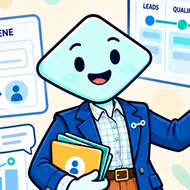 Yael, the RevOps teammate, reviews your open deals. It picks out those whose expected close date has passed or whose record hasn't been edited for a number of days you set, each with its exact reason: "expected close 12/09, 30 days overdue". The table is calculated from the records, not written by the AI, and arrives with a short comment to approve.
In the same team,  Maé, the proposals teammate, spots deals whose stage says a proposal has gone out ("proposal", "quote", "offer", provided your CRM spells it out) and that nobody has touched for ten days by default. It prepares one short follow-up draft per deal. You read it, adjust it, send it.
Their limits are those of what they read: your CRM records. They don't see the history of exchanges, so they don't know who was supposed to follow up, and the draft is written from the record alone.
What changes: instead of looking at the deals you open out of habit, the team sees the ones nobody has looked at.
 Kim, the Customer Success teammate, runs several complementary missions. Three of them:
Imagine a strategic customer, [Client A], who keeps opening tickets even though a feature was promised in a meeting three months earlier. The promise is in one meeting summary, the tickets in another tool. On Thursday, before the meeting, the brief puts them side by side: the promise appears among the open commitments, next to the recent tickets. You walk in knowing it, without having had to dig.
Commitments come from meetings recorded in Ragnight, and tickets and emails only appear if they sit in a base you can read.
What changes: you no longer discover the problem the day the customer raises it. You arrive prepared.
A teammate that takes initiative on bad information only speeds up the mistakes. That is why so many agent projects fail on the knowledge layer, not on the model.
 Alix, the knowledge-quality teammate, watches over what all the others read. It flags passages that contradict each other ("document A says X, document B says Y") and documents unchanged for a long time that the assistant still cites. Every week, it puts the unanswered questions to your bases again: as soon as a document answers one, the person who asked is notified, with the answer and its sources. Contradictions and stale documents land in the Review Center: you arbitrate.
Several teammates, several functions, one body of knowledge.
A teammate spots, prepares and proposes. It sends nothing to your customers or prospects on your behalf: follow-ups, meeting summaries and follow-up emails are drafts handed to the person concerned, or proposals filed for approval.
One exception, and it is a choice: teammates that answer a question someone asks (your website's support chat, Slack) answer directly, from your bases, with their sources.
And autonomy is earned, action by action. For a given type of action (a drafted document, say), Ragnight offers to drop your approval once you have approved enough of them with no refusal. It is always you who grants it, and you can take it back at any time.
The teammate takes the initiative. The human keeps the hand.
Don't try to automate a whole function. Pick one important responsibility your team follows less regularly than it would like: proposals left unanswered, customer commitments hard to find, documents that contradict each other.
Give the teammate a few complementary missions around that topic, see what it surfaces, then widen. Each mission states what it reads (CRM, calendar, recorded meetings): connect those sources first.
The assistant answers when asked, the agent carries out what it is given. The teammate holds a role: it follows what falls under it, surfaces what deserves your attention and prepares the next step. It doesn't replace your team, it saves it the time spent searching, checking and preparing, so it can spend more of it deciding and supporting.
They spot. They prepare. You decide.
Go further
By team
What we offer
Knowledge & AI
RAG, or Retrieval-Augmented Generation: the method that connects an AI to your documents for reliable, sourced answers. Explained without the jargon.
 Knowledge & AI
Gartner expects over 40% of agentic AI projects to be scrapped by 2027. The real cause is not the model, it is the knowledge layer. Fund the truth layer before the agent layer.
 Knowledge & AI
ChatGPT is brilliant as a generalist, but it doesn't know your contracts, your policies, or who's allowed to see what. Here's what actually closes that gap.
Upload your files and run your first RAG pipeline in 5 minutes.

Lia
Ragnight product advisor